
Proof of Concept: Field Applications
The Savant Alaunt is a working breed evaluated not by description, but by demonstration. The material presented here reflects real-world exposure to quarry and environmental pressure. It is not intended as a comprehensive record of field work, but as a measured representation of how the dogs are being developed, evaluated, and advanced towards their historically accurate functional purposes.
A few dogs exhibiting hunting capabilities is not representative of our line - and we will continuously be evaluating subsequent stock for strength of ability. Below are our F1s and foundation brood stock exploring viable hunting applications.
Savant’s Gus - F1 Alaunt
Evaluation and Development
The Savant Alaunt is a breed in development, and is observed through continuous exposure and evaluation. We don’t separate these processes because ultimately - everyday is an “evaluation day”. We break down development and maturation into multiple phases to prove brood stock and breed worthiness, and we measure a dog’s progression against non-negotiable, functional criteria.
16 week old Foundation Brood Stock F1 Uzi.
Early stages establish the foundation - we value structural soundness, environmental stability and a baseline temperament. They must be good at being a NORMAL DOG. That mean's they’re capable of navigating everyday society, new environments, life indoors and out, trips in public - the basics. The dogs must demonstrate composure and clarity in varied settings before higher demands are introduced.
Drive expression is observed. This includes pursuit behavior, engagement with movement, and the dog’s response to frustration. Games of fetch, flirt pole, back tie work, engagement with tug toys. At this stage, emphasis is placed on how instinctual behaviors present themselves - whether they must be manipulated, or directed, consistent and recoverable.
Controlled exposure comes next. We introduce dogs to pressure in measured environments, allowing for evaluation of decision-making, physical coordination, and behavioral stability under increasing demand. These scenarios are not designed for outcomes - but for observation of processes. That could be civil aggression development, defense and territorial aggression evaluation, or heavy environmental exposure in more stressful environments like working kennels, farmer’s markets, parades, and large crowds.
Field application represents the extension of this progression. Variables are less controlled, and the dog is required to operate within real world conditions. Performance is assessed not by a single result, but how the dog carries itself through pursuit, engagement and resolution. Field applications often take place alongside seasoned and proven dogs to help the dog learn by example.
Across all these stages, our evaluation encompasses four constants:
Structure under resistance - how well do the dog’s bodies hold up under repeated physical demand. Do they recover well, are they capable of rapid physiological adaptation, and do their bodies heal efficiently.
Instinct in pursuit and engagement - we seek to ensure their is consistency in clarity and intent of drive and predatory instincts.
Temperament under pressure - who is the dog when things are “no longer fun” , do they retain resolve, composure and committment to the task at hand.
Efficiency in resolution - we assess the ability to complete tasks without excess or degradation. What is the dog’s preferred combat style? Are they back end dogs, head and throat dogs, are they brawlers who take damage, or strategic “in and out” types?
Not all dogs progress equally, and not all are advance to the same level. Selection occurs at each stage based on observed performance within these criteria. The objective is not to produce isolated results, but to establish repeatable patterns of behavior across environments and conditions.
No single moment defines the dog. Development reveals it.
Selection pressure, Quarry, and Function
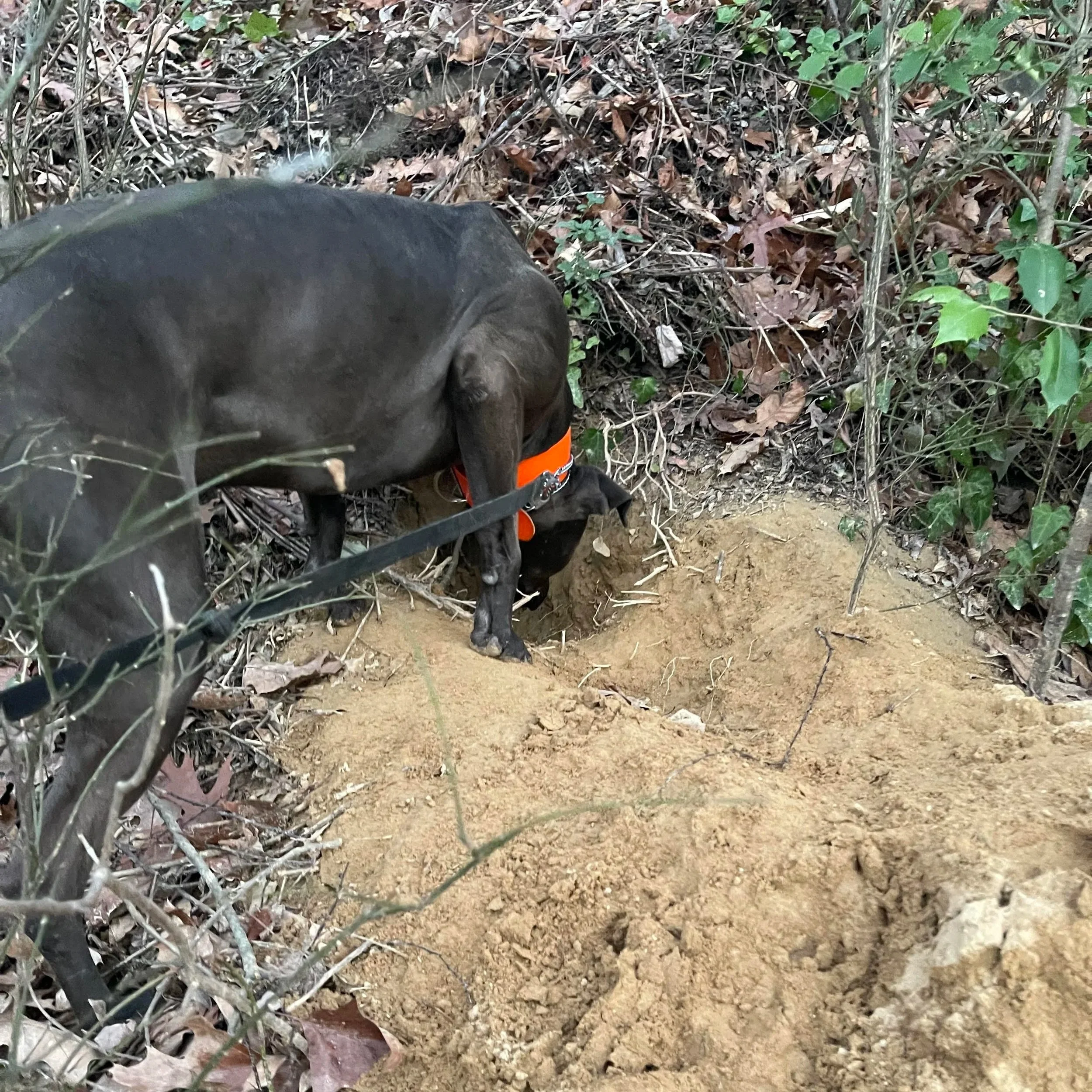
Nero waiting for the fox to be flushed from a den by a Patterdale Terrier.
Working dogs are not defined in isolation. They are shaped by the combined pressures of geography, quarry, and use. Across generations, these variables determine not only what a dog must do, but what it must be.
In the Mid-Atlantic region of the United States, these pressures are distinct. The landscape is neither wide open planes, or heavily forested hardwoods; it is a combination of urban, suburban, and rural environments. Game persists in fragmented habitats—woodlots, agricultural edges, drainage corridors, and developed spaces. As a result, these working dogs must demonstrate not only physical ability, but reliability and versatility across inconsistent terrain and proximity to human activity.
Selection in this context prioritizes dogs that are adaptable, controllable, and environmentally stable, capable of functioning without degradation of performance regardless of setting.
Vermin Quarry: Baseline Requirements
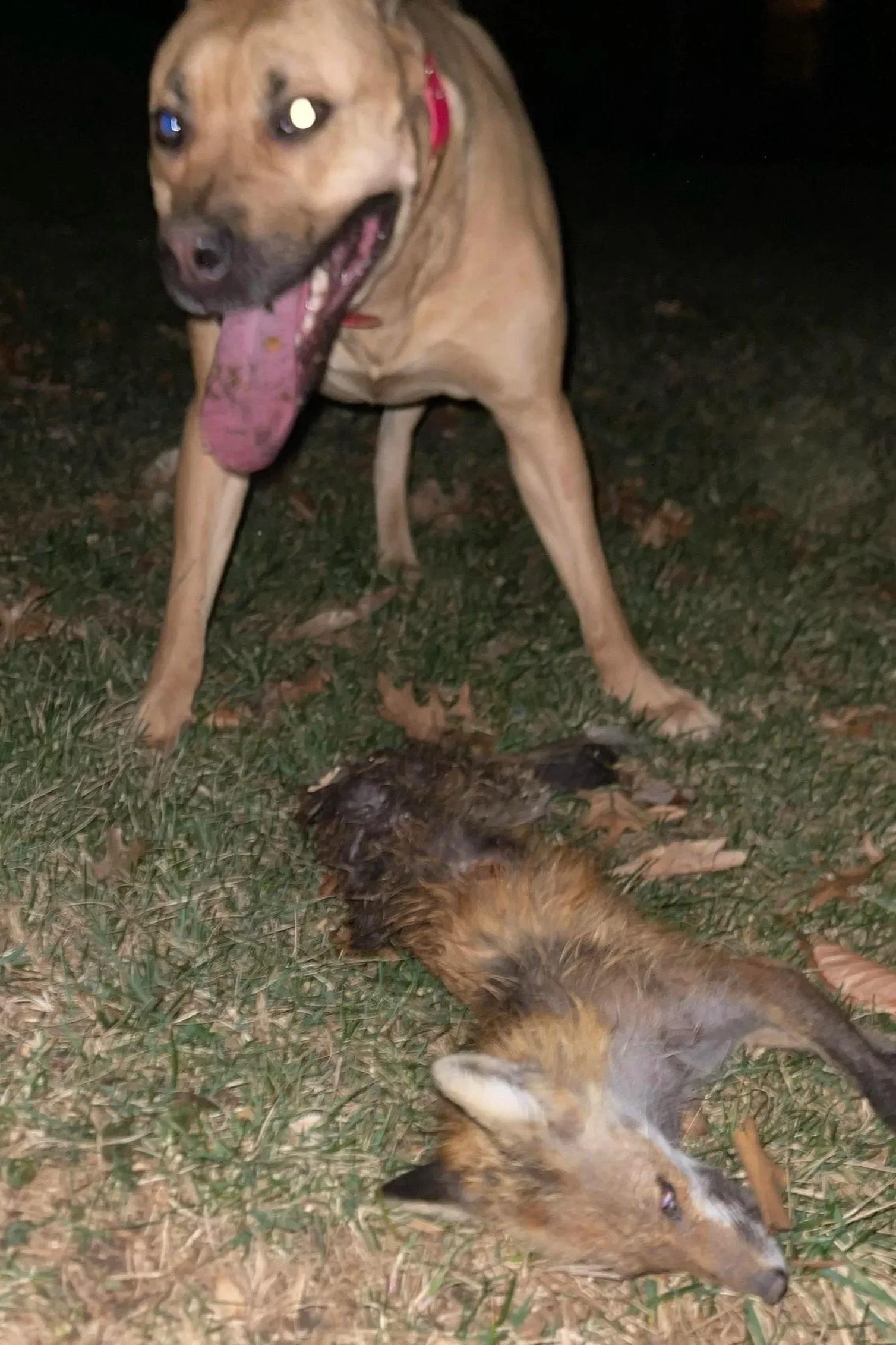
Savant’s Uzi and a young fox.
Vermin species such as raccoon, fox, and groundhog establish the baseline for evaluating a dog’s functional completeness. These animals are not incidental quarry; they represent frequent, accessible, and variable tests of instinct, coordination, and resolve.
Each presents a distinct problem.
Groundhog
Groundhogs rely on burrow systems and proximity to cover. Engagement is typically brief and opportunistic, often occurring when the animal is flushed. The dog must demonstrate quick recognition, acceleration, and precise capture. Retrieval of flushed quarry places emphasis on responsiveness and control, requiring the dog to transition cleanly from pursuit to possession.
Raccoon
Raccoons are among the most formidable small quarry. They possess dexterity, problem-solving ability, and a willingness to engage defensively. When cornered, they will stand their ground, using claws, teeth, and environmental positioning to their advantage. For the dog, this demands coordination in close quarters, durability, and the ability to resolve engagement efficiently. Hesitation or lack of precision results in prolonged conflict.
Fox
Fox represent a different category of work. As coursing quarry, they test endurance, visual acuity, and adaptive pursuit. Fox rely on evasion—utilizing terrain, directional changes, and distance rather than direct confrontation. Dogs used in this context must be leggy, efficient movers, capable of maintaining visual contact and adjusting dynamically to movement. The pursuit is as much cognitive as it is physical.
All materials here document legal and ethical hunting practices. The emphasis is on observed behavior and demonstrated capability, rather than anecdotal claims
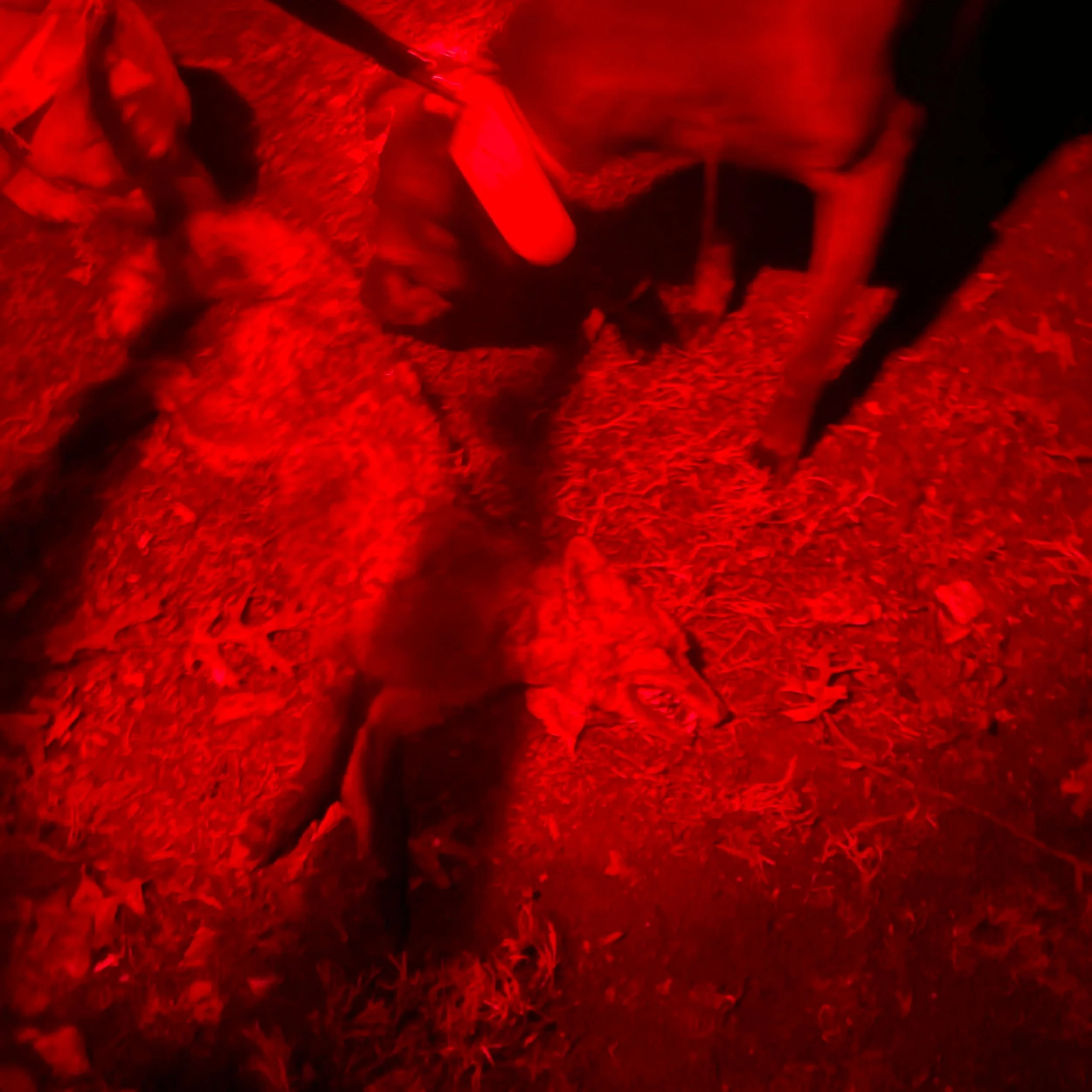
Nero after a night run.
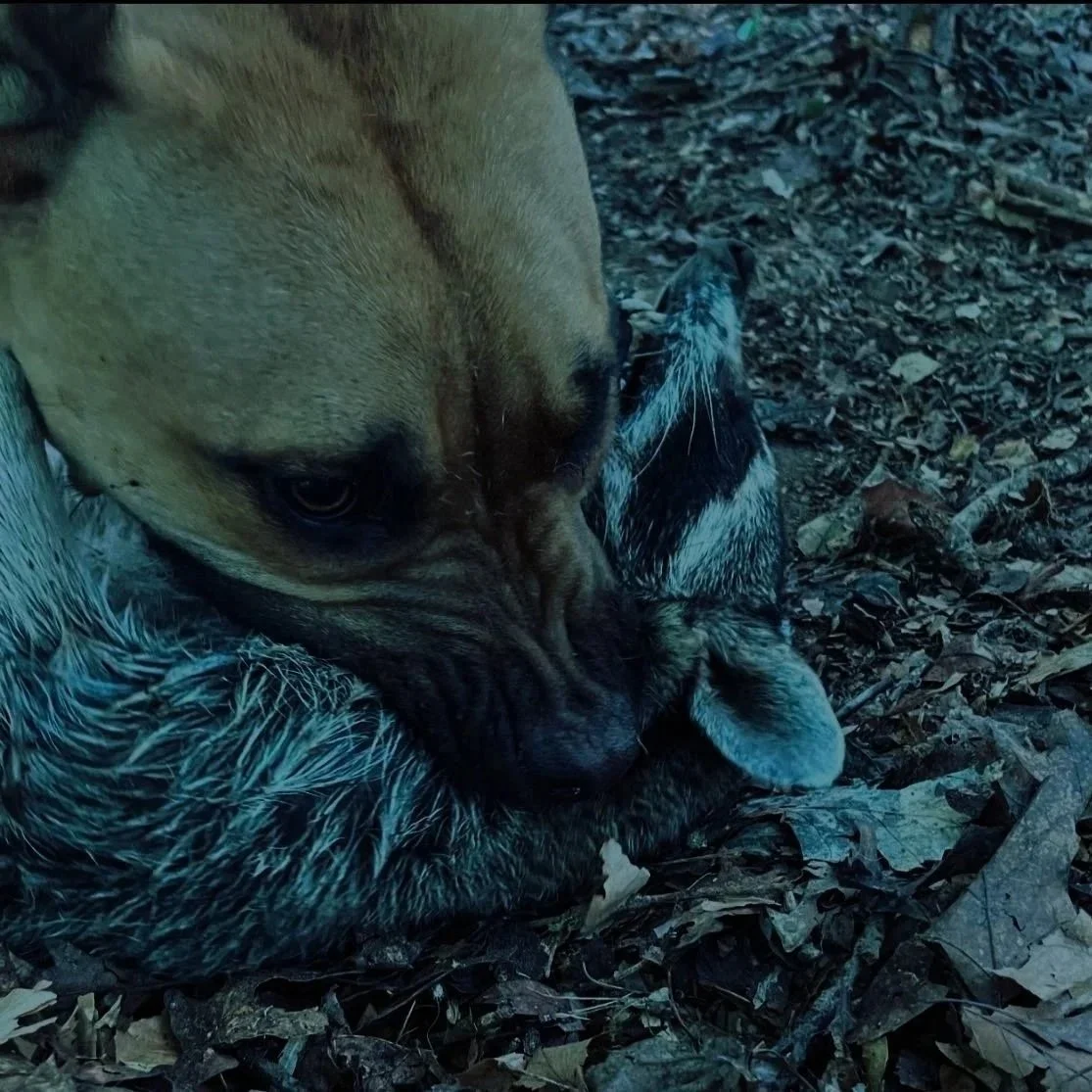
Uzi learning targeting.
Tools of Quarry, Requirements of the Dog
Across these species, a pattern emerges: each quarry survives through a combination of evasion, defense, and environmental use.
Burrowing (groundhog) limits access and compresses engagement windows
Dexterity and aggression (raccoon) create risk in close quarters
Speed and evasiveness (fox) extend pursuit and test endurance
These pressures select for dogs that are:
Structurally sound– able to absorb impact and maintain function
Leggy and efficient – capable of covering ground without waste
Mentally stable – able to remain task-oriented under stress
Decisive in engagement – targeting effectively to end conflict
Convergence of Type and Function
The resulting type is not accidental. It is a convergence of functional requirements expressed physically and behaviorally.
Mastiff influence provides mass, density, and a degree of subcutaneous protection—allowing the dog to absorb impact and remain effective in close engagement.
Bulldog influence contributes mental tenacity, tolerance for pressure, and the willingness to engage and persist without hesitation.
Sighthound influence defines the predatory framework—vision-oriented pursuit, efficient movement, and a drive not merely to engage, but to finish.
This combination is deliberate. Mass without mobility limits pursuit. Drive without control prolongs conflict. Speed without resolve fails at engagement.
The Savant Alaunt is shaped to unify these elements into a single expression: a dog that can locate, pursue, engage, and resolve without fragmentation of purpose. It does not seek prolonged contest. It does not operate in phases. It is bred to identify, close and finish.
Transition to Large Quarry: Feral Hog
Feral hog introduce a separate class of demand. Unlike vermin, hog are not simply evasive or defensive—they are capable of sustained resistance and counter-aggression. Engagement requires coordination between dogs and a higher degree of structural and mental resilience.
Savant’s’ Gus - first time in the field being used as a drop dog.
Two primary roles emerge:
Lead-In Catch Dog
A dog deployed at close range, often released once a hog is located and pressured. This role emphasizes strength, grip, and the ability to secure the animal in a controlled manner.
Running Catch Dog
A dog capable of pursuing, closing distance, and engaging without staged deployment. This requires the combined attributes of a running dog and a catch dog—speed, endurance, structural integrity, and immediate engagement capability.
Central to this requirement is behavioral consistency. The dog must regard the quarry the same whether in flight or held at bay. Distance, pressure, or presentation of the hog does not alter intent. There is no hesitation in transition, no escalation beyond necessity, and no reliance on external prompting.
The work remains continuous—pursuit, engagement, and resolution expressed as a single, unified function.
The Savant Alaunt in Application
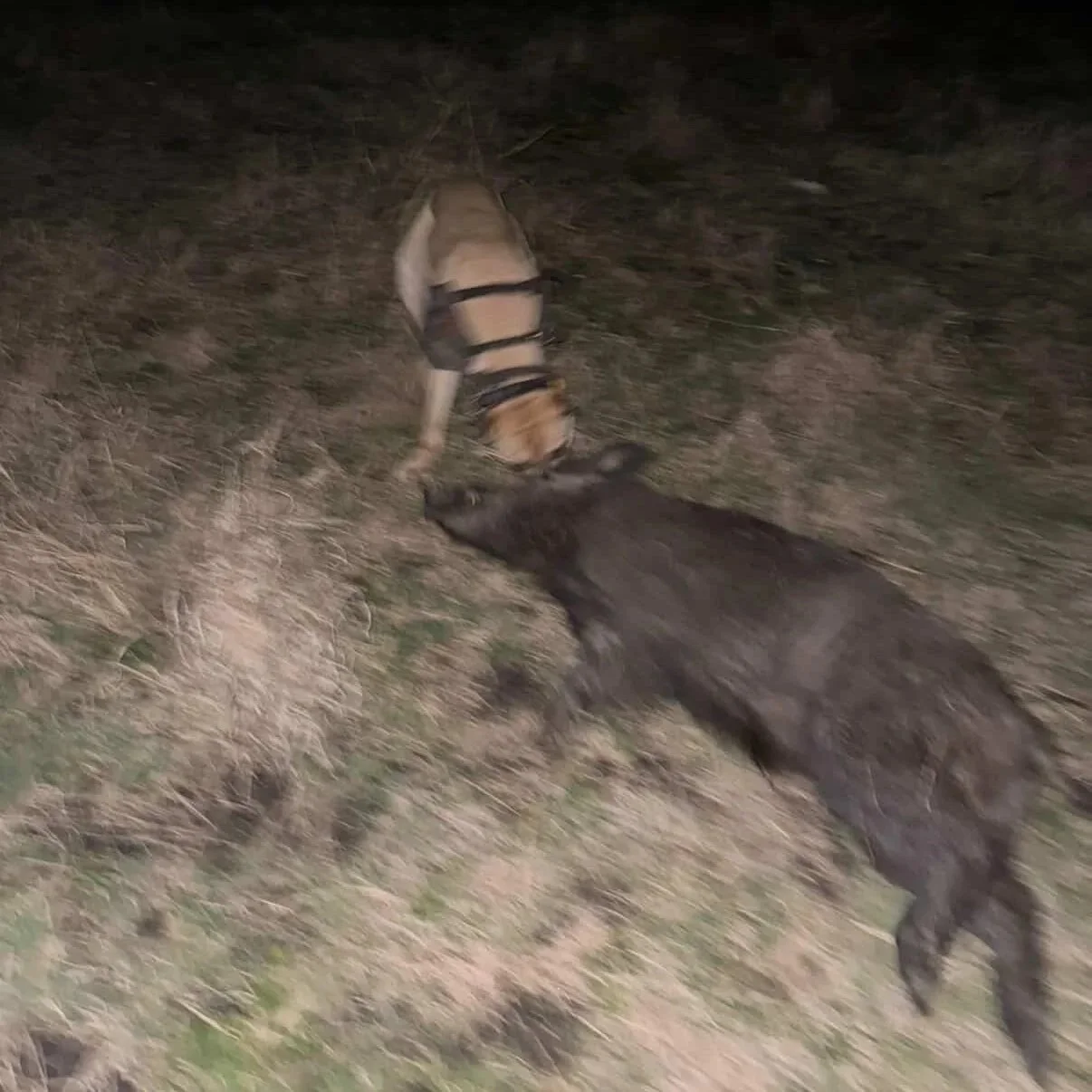
Savant’s Gus with a 130lb boar hog.
The Savant Alaunt is developed within this framework of layered demands.
It is not specialized to a single expression of work, but shaped by overlapping selection pressures:
Pursuit-based work requiring speed and visual tracking
Close-quarters engagement requiring durability and precision
Environmental variability requiring stability across contexts
While capable in both roles, the Savant Alaunt demonstrates particular alignment with the running catch function—where pursuit and engagement are not separated, but continuous.
This requires a dog that can:
Locate and close without hesitation
Transition seamlessly from pursuit to engagement
Maintain composure under resistance
Resolve efficiently without loss of control.
The form of the Savant Alaunt is not aesthetic. It is the cumulative result of applied pressure—geography, quarry, and task. Each element of structure and behavior reflects a requirement observed in the field.